


The back-end environment supporting retail trading platforms has undergone a massive transformation that completely reshapes how orders route through the global financial plumbing. A decade ago, retail traders regularly wrestled with sluggish processing terminals, opaque dealer marks, and severe network latency. Today, deep institutional upgrades have trickled down to standard workspaces, matching the speed and efficiency once reserved exclusively for high-freight investment funds.
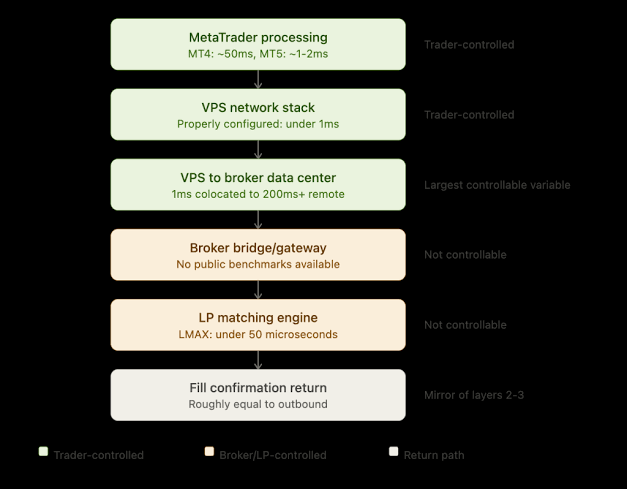
How multi-layered execution channels compress network latency to sub-millisecond ranges. Source: Forex VPS Hosting
How has order execution routing shifted away from the old dealer models?
Go back ten years, and the retail brokerage layout was heavily dominated by fixed-spread dealing desks. Under that principal setup, the intermediary frequently internalized your risk, manually generating buy and sell quotes while taking the direct opposite side of your active portfolio positions.
This older layout routinely sparked severe structural friction, leading to frequent manual re-quotes and massive processing delays when markets turned hectic. Modern platforms have largely abandoned this restrictive arrangement, moving toward unbundled Electronic Communication Network (ECN) and Straight-Through Processing (STP) setups. Your trade entries bypass manual desk interventions completely, traveling down high-speed pipelines right into automated matching systems where multiple primary clearinghouses cross contracts transparently.
Why have display spreads dropped so drastically across standard pairs?
The decline in baseline transaction costs is a direct result of multi-bank price aggregation technology running on modern servers. A decade ago, a broker generally linked their terminal feed to a single wholesale counterparty, forcing users to pay whatever premium that individual bank demanded.
Modern systems scan live pricing streams across dozens of top-tier global banks simultaneously. The price engine automatically grabs the highest active bid from one institution and pairs it with the lowest active ask from another, compressing the central gap. Think of this gap exactly like an entrance fee or a non-negotiable service charge; when heavy competition forces the gates closer together, your upfront entry toll plummets. Securing a workspace with advanced low spread forex brokers lets you trade inside this optimized aggregation layer where pricing metrics regularly hit absolute zero.
What technical breakthroughs allowed execution latency to collapse?
The race to eliminate execution lag pushed brokerage firms to overhaul their entire physical server architecture over the last ten years. In the mid-2010s, your trade packets often meandered through public internet pathways to reach random corporate office servers, introducing massive data bottlenecks.
Firms solved this structural lag by co-locating their primary enterprise hardware nodes right inside elite financial data hubs like Equinix LD4 in London or NY4 in New York. Connecting your platform to the best forex broker for mt5 links your local terminal straight to these co-located hardware clusters. Replacing public web routing with direct, localized fiber-optic cross-connects has collapsed processing intervals from several hundred milliseconds down to sub-millisecond ranges, ensuring your orders clear the ledger before live quotes can slip away.
How has the definition of market access expanded for retail accounts?
Historically, setting up a diversified portfolio required managing several isolated trading accounts, each tied to specific asset classes or separate specialized providers. A retail user looking to trade major currencies, global equity indices, and physical commodities had to jump between disconnected apps constantly.
Modern multi-asset infrastructure completely erases these borders, allowing you to deploy capital across thousands of global instruments through a single integrated interface. Smart contract routing engines handle disparate execution loops seamlessly behind the scenes. This unified architecture gives you the freedom to balance your equity risk across traditional pairs, precious metals, and modern digital asset channels simultaneously without needing to maintain separate margin accounts or re-allocate your funds across fragmented web wallets.
How did the transition to cloud infrastructure improve platform uptime?
In earlier platform eras, a sudden surge in global volume during high-impact economic news releases would routinely trigger catastrophic server crashes. The sudden bottleneck of incoming traffic would choke the broker’s singular matching engine, freezing terminal screens and leaving traders unable to manage open risk.
Modern platforms insulate your capital from these technical blackouts by building absolute cloud redundancy into their backend networks. They deploy multi-tiered failover server loops that dynamically distribute computing stress across global server nodes in real time. If a specific data pipeline chokes or experiences a physical power drop, automated systems reroute your active trading session to an identical backup node within milliseconds. This continuous stabilization layer keeps your platform online, updates price charts smoothly, and protects your positions from unexpected connection drops.
Practical Action Plan
Stop managing your modern trading portfolio on obsolete technical assumptions or unoptimized home setups. Open your platform settings today, run a localized network diagnostic to measure your real-world ping latency to your broker’s data servers, and verify that your script loops update at sub-millisecond speeds. By shifting your active strategies away from slow, fixed-markup accounts and executing your positions strictly through advanced, unbundled multi-bank aggregation streams during peak market hours, you can naturally eliminate structural transaction leaks and run your trading with total operational precision.
