

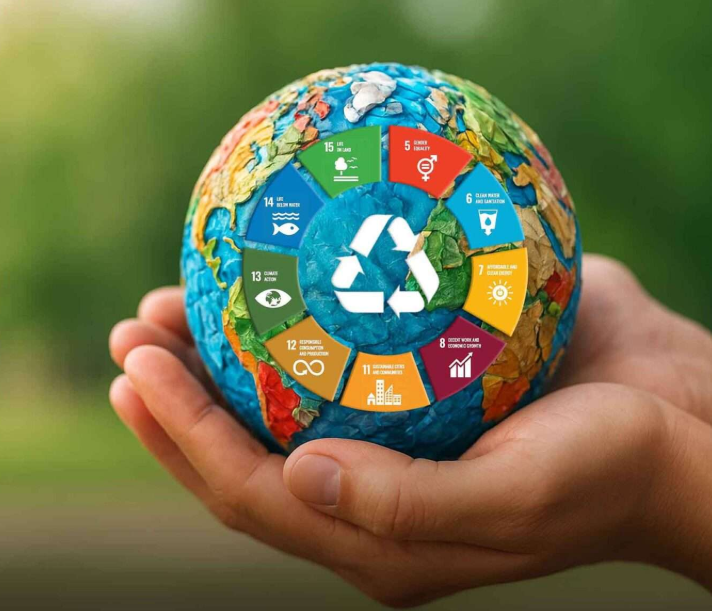
Sustainable Development Goals (SDGs) are the UN’s shared plan to improve lives and protect the planet by 2030. They cover everything from health and jobs to cities, climate, and biodiversity. Recycling often gets treated like a basic “good habit,” but it’s more than that. Done well, it improves how communities manage waste, reduces leakage into the environment, and supports the circular use of materials. Done poorly, it becomes a checkbox—collected waste that never gets recycled, high contamination, and claims that don’t match reality.
This blog explains the Sustainable Development Goals connection in a way you can use: which goals recycling supports most directly, what “good recycling” actually looks like, and how businesses and communities can measure progress instead of guessing.
What you’ll learn
- A clear SDG refresher
- The SDGs recycling supports most (with practical examples)
- A simple recycling scorecard you can track monthly
- Actions for brands, cities, and households that make recycling “count”
SDGs in one minute: what they are and why they matter
The SDGs are 17 goals adopted by UN member states in 2015, supported by targets and indicators to track progress. That matters because sustainability can’t be only a slogan. When the goal is measurable, you can compare outcomes across years, sites, suppliers, and communities—and improve what’s not working.
Why recycling matters now (but can’t carry the whole burden)
The global numbers make one thing clear: we cannot recycle our way out of the plastics problem, but we cannot ignore recycling either. OECD analysis estimates that only about 9% of plastic waste is recycled globally, while the rest is landfilled, incinerated, or mismanaged.
So the honest approach is “reduce + reuse + recycle”—in that order. Recycling is strongest when it’s part of a broader circular plan:
- Reduce unnecessary packaging and material use
- Design what remains so it can be recycled in real systems
- Recycle effectively, with a stable demand for recycled output
Banyan Nation’s SDG-focused view aligns with this systems approach: recycling turns waste into a usable resource and supports a circular economy, not just waste collection.
The SDGs recycling supports most, and how
SDG 12: Responsible Consumption and Production
If you link recycling to one SDG, it’s SDG 12. It focuses on resource efficiency and reducing waste through better production and consumption patterns.
Recycling supports SDG 12 by keeping materials in circulation and reducing demand for virgin extraction.
What “good” looks like for SDG 12
- Packaging is designed to be recyclable (not a mix of materials that can’t be separated)
- Waste is segregated at source (cleaner feedstock = higher recycling yield)
- Recycled content is used in new products—closing the loop
Business action (quick wins)
- Set recycled-content goals by component (bottle vs cap vs label), not vague “recycled packaging”
- Build supplier requirements: traceability, quality specs, and third-party verification where possible
- Track yield (how much becomes usable output), not only “tonnes collected”
SDG 11: Sustainable Cities and Communities
Cities rise or fall on waste systems: segregation, collection, sorting, and safe processing. Sustainable Development Goal 11 includes reducing cities’ environmental impact, including municipal waste management.
When recycling systems work, cities benefit from cleaner public spaces, reduced landfill stress, and fewer open dumping hotspots.
City/community action
- Make segregation dead simple: “wet” and “dry” with visuals and consistent rules
- Build sorting capacity (because collection without sorting becomes transport-to-landfill)
- Publish outcomes monthly: collected vs sorted vs recycled vs rejected
SDG 13: Climate Action
SDG 13 focuses on urgent action on climate change.
Recycling can support climate goals by reducing reliance on energy-intensive virgin production. But climate impact varies by material, local electricity grid, transport distances, and contamination rates—so avoid one-size-fits-all carbon claims.
Better climate metric than “tonnes recycled”
- Track virgin material avoided (kg) and recycled content used (kg) alongside recycling volumes.
Those metrics are closer to the real substitution effect.
SDG 14 & SDG 15: Life Below Water and Life on Land
Plastic leakage is a visible SDG problem because it harms ecosystems directly. UNEP estimates 19–23 million tonnes of plastic waste leak into aquatic ecosystems each year.
Better recycling helps by capturing materials before they reach drains, rivers, coastlines, and soil.
Leakage-first action
- Prioritise collection around waterways, markets, and transit corridors
- Create take-back programs for hard-to-collect plastic formats
- Measure “leakage risk reduction” (where you recover matters, not only how much)
SDG 8 & SDG 9: Decent Work, Industry, and Infrastructure
Recycling is also jobs and industrial capacity: collection, sorting, processing, testing, logistics, and manufacturing. The World Resources Institute highlights the importance of improving conditions and integrating waste workers more safely and formally.
People + industry action
- Put safety and dignity into KPIs: PPE, fair pay, heat protection, training
- Use long-term offtake commitments to stabilise demand for recycled materials
- Treat recyclers like critical suppliers—quality standards and documentation matter
The Recycling Scorecard: 3 numbers that stop “recycling theatre”
If you only track one metric, you’ll get shallow outcomes. Track these three instead:
- Diversion rate: % of waste generated that is sent to recycling (not just “collected”)
- Yield: % of that diverted waste that becomes usable recycled output after sorting/processing
- Recycled content used: kg (or %) of recycled material actually used back in products/packaging
This scorecard forces honesty: it rewards quality, not just activity.
Where Banyan Nation fits in the SDG story
Banyan Nation connects recycling to SDG outcomes by focusing on how waste can become a reliable resource stream—supporting circularity, climate outcomes, cleaner communities, and reduced environmental leakage when recycling is executed with quality and traceability. That framing matters: in SDG terms, progress isn’t “we tried,” it’s “we can prove it worked.”
Endnote
Recycling supports SDGs when it’s treated as a full system—segregation, collection, sorting, processing, and stable demand for recycled output—backed by measurement and transparent communication. It can directly support SDG 12, strengthen waste systems for SDG 11, contribute to SDG 13 through the substitution of virgin materials, and reduce leakage affecting SDG 14 and SDG 15. If you want recycling to deliver real Sustainable Development Goals progress, don’t aim for the loudest claim. Aim for the cleanest data.
